
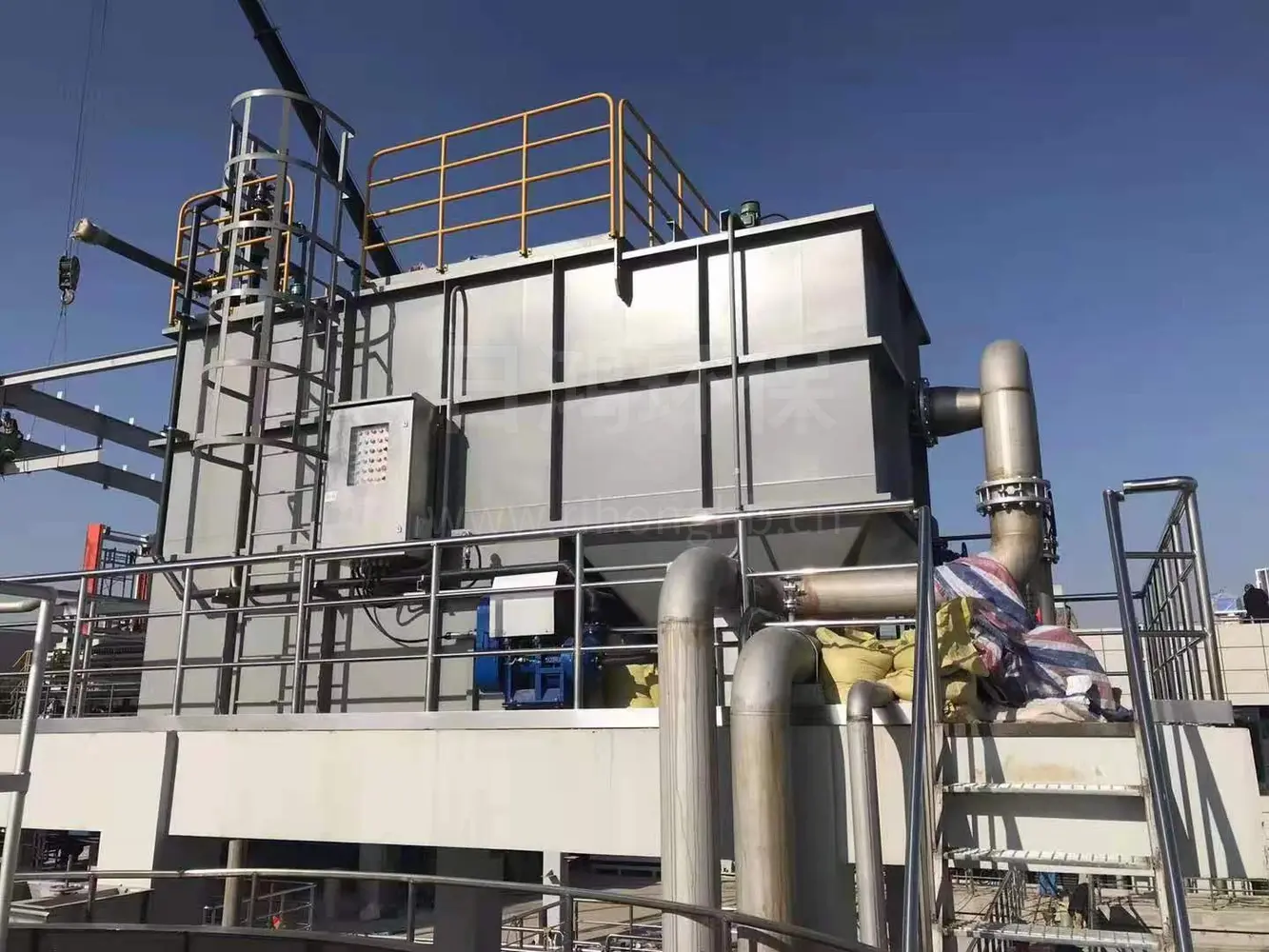
High-Density Rapid Sedimentation Water Treatment Equipment
When facing water treatment scenarios with high turbidity, high suspended solids, low temperature and low turbidity, or limited land availability, the traditional problems of conventional coagulation and sedimentation—"low surface loading rate, bulky tank volume, slow start-up"—are always unavoidable. Rihong Environmental's High-Density Rapid Sedimentation Water Treatment Equipment (also known as micro-sand sedimentation tank, Actiflo-type ballasted sedimentation) uses fine quartz sand as the "weighting skeleton" of flocs, combined with high-speed inclined tube separation and micro-sand cyclone recovery and circulation. The surface loading rate can reach several times that of traditional sedimentation, allowing the sedimentation tank to "slim down by half while producing more stable effluent," providing a compact and efficient technical route for wastewater treatment plant upgrading and capacity expansion, stormwater overflow treatment, and industrial high-turbidity wastewater.
I. Product Positioning: What Kind of Equipment Is It
The High-Density Rapid Sedimentation Water Treatment Equipment is the equipmentized form of micro-sand ballasted sedimentation (Actiflo-type / high-density rapid sedimentation) technology, and also an accelerated and slimmed-down version of the traditional "coagulation + sedimentation" process. On the basis of conventional coagulation and sedimentation, fine quartz sand (micro-sand) is added. The micro-sand serves as the "nucleation core" and "weighting skeleton" of the flocs, working synergistically with coagulants and flocculant aids to form dense, heavy, and extremely fast-settling sand-ballasted composite flocs, achieving high-speed solid-liquid separation in the inclined tube zone; the sand-containing sludge then undergoes hydrocyclone separation of mud and sand, with micro-sand recovered and recycled, and concentrated sludge discharged for dewatering.
The equipment adopts a modular steel integrated design, integrating rapid mixing, micro-sand flocculation, inclined tube sedimentation, micro-sand recovery, and chemical dosing control into one unit. It can be installed above ground, expanded in parallel modules, and is ready to use upon connection. The core logic in one sentence: Use micro-sand to "add weight" to flocs, making sedimentation faster and the tank smaller.
II. Product Highlights
① Fast settling, space-saving Sand-ballasted heavy flocs settle extremely quickly, and the inclined tube zone operates at high surface loading rates. The footprint is significantly reduced compared to traditional sedimentation tanks, making it especially practical for upgrading projects.
② Stable effluent, impact-resistant Strong adaptability to fluctuations in water quantity and quality as well as low-temperature and low-turbidity conditions. Effluent SS / turbidity is stable and controllable, with strong resistance to shock loads.
③ Fast start-up, start and stop on demand Pure physicochemical process with no biochemical acclimation period; effective immediately upon start-up. Suitable for intermittent operation, seasonal peaks, and emergency treatment.
④ Micro-sand circulation, low loss Closed-loop operation with cyclone recovery. Micro-sand can be used long-term after a single addition, with minimal sand replenishment and low operating costs.
⑤ Compact modular design, ready to use Integrated steel tank, above-ground installation, flexible parallel expansion. Friendly for both new construction and retrofit projects.
⑥ Synergistic phosphorus removal, upgrading tool Combined with chemical phosphorus removal agents, it simultaneously achieves advanced phosphorus removal and SS removal, supporting Grade 1A / quasi-Class IV upgrading.
III. Working Principle (Brief)
Chemical dosing and mixing: Raw water enters the rapid mixing zone and is thoroughly mixed with coagulant, completing destabilization of colloidal particles.
Micro-sand flocculation: Flocculant aids and recycled micro-sand are added. Micro-sand acts as the floc skeleton, forming dense and heavy sand-ballasted composite flocs that are shear-resistant and fast-settling.
High-speed inclined tube sedimentation: Sand-ballasted flocs enter the inclined tube separation zone and settle rapidly. Clear water is discharged from the upper collection system, while sludge settles to the bottom for thickening.
Micro-sand recovery and circulation: Sand-containing sludge at the bottom is pumped to a hydrocyclone for mud-sand separation—micro-sand returns to the flocculation zone for reuse, and concentrated sludge is discharged for dewatering.
Process flow: Raw water → Rapid mixing (destabilization) → Micro-sand flocculation (sand-ballasted heavy flocs) → High-speed inclined tube sedimentation → Micro-sand cyclone recovery and circulation / Sludge discharge
The core lies in "weighting with sand": micro-sand simultaneously increases the density and particle size of flocs, multiplying the settling velocity, so the tank can be made smaller with higher surface loading rates; micro-sand continuously circulates and is reused within the system with extremely low loss, requiring only a single addition for long-term operation. At the same time, it does not require the lengthy cultivation and acclimation period of biochemical processes—effective immediately upon start-up, start and stop at will—making it particularly suitable for intermittent and seasonally fluctuating treatment scenarios.
IV. Typical Application Scenarios
Wherever there is "turbidity, high SS, phosphorus removal needed, insufficient land, or rapid start-up required," the High-Density Rapid Sedimentation Water Treatment Equipment is usually a priority candidate. The following are the most typical implementation scenarios:
Industry / Wastewater Type | Main Removal Targets |
|---|---|
Municipal wastewater plant upgrading / capacity expansion | Advanced SS and phosphorus removal, chemical primary enhancement |
Combined sewer overflow (CSO) / Stormwater treatment | Rapid removal of SS and particulate COD, reducing overflow pollution |
Steel / Coal chemical / Coal washing wastewater | High-concentration suspended solids, coal slurry, dust |
Stone / Building materials / Grinding wastewater | Rapid separation and reuse of high-turbidity suspended solids |
Low-temperature and low-turbidity raw water for water supply plants | Enhanced coagulation and sedimentation, shortened retention time |
Industrial wastewater pretreatment | Pre-removal of turbidity for high SS and high turbidity, reducing load on subsequent processes |
Emergency / Seasonal treatment | Start and stop on demand, rapid deployment |
Additional scenarios: In upgrading projects where it is difficult to add new sedimentation tanks due to land constraints, this equipment can serve as a "compact weapon" for advanced phosphorus and SS removal, and can also function as a flexible capacity expansion unit during dry/rainy season flow fluctuations; during rainy season overflow with large flow and rapid inflow, it is effective immediately upon start-up with high surface loading rates, significantly reducing SS and particulate COD in a short time, mitigating impact on receiving water bodies.
V. Applicable Boundaries and Selection Recommendations
This equipment is more suitable for high-turbidity and high-SS removal, chemically enhanced phosphorus removal, upgrading and capacity expansion with limited land, and stormwater overflow treatment. It should be clearly understood that it is a pure physicochemical separation process, mainly removing suspended and some colloidal pollutants, with essentially no removal capacity for dissolved COD, ammonia nitrogen, or total nitrogen—if your water quality is dominated by dissolved pollutants, it should be used as a pre-treatment turbidity and phosphorus removal unit, combined with biochemical or advanced treatment processes to form a complete compliance chain. When selecting, consider the following:
Consideration | Recommendation |
|---|---|
Large water quality fluctuations | Recommend pre-equalization to stabilize influent load before entering the main unit |
Chemical dosing combination | Coagulant and flocculant aid selection and dosage should be determined through jar tests / on-site pilot tests |
Sand-containing sludge dewatering | Subsequent dewatering equipment should consider wear-resistant configuration |
Operating parameters | Surface loading rate values should be combined with raw water quality; pilot tests are recommended before commissioning |
* This page is a product introduction and does not involve specific design calculations; equipment specifications, parameters, and removal performance vary with raw water quality, chemical combination, and operating conditions, and must be based on formal design and on-site testing.
FAQ
How much does this equipment cost?
The price varies by treatment capacity, water quality, materials and configuration, so a custom quote is provided based on your actual conditions. We offer free water testing and solution design, with a detailed quote within 1 working day after requirements are confirmed.
What treatment capacity is available? Can it be customized?
Capacity is fully customizable, ranging from tens to thousands of tons per day (e.g. 0.5–30 m³/h), with non-standard design support matched precisely to your inlet/outlet requirements.
How long does delivery take?
Standard equipment typically takes about 2–4 weeks to produce; custom projects depend on scale and process. The delivery date is confirmed at contract signing, with design, manufacturing and shipping progressing on schedule.
Is installation and commissioning included?
Yes. We provide installation, system commissioning, operator training and environmental acceptance assistance, as well as long-term managed operation services on request.
What about after-sales and warranty?
We provide a warranty period and a 24/7 technical hotline, with free repair for non-human faults during the warranty period, plus spare parts supply and regular inspection services.
Let high-turbidity water "settle" fast and stable
Tell us your water quality, quantity, and discharge requirements. We can provide pilot testing, chemical dosing combination optimization, and integrated equipment selection solutions. Welcome to call or leave a message.
Contact Us Now →Related Products

High-Density Sedimentation Tank
In scenarios such as water supply purification, advanced wastewater treatment, and hardness and fluoride removal from industrial wastewater, traditional sedimentation tanks often fall into the dilemma of "large footprint, low surface loading rate, poor effluent quality under low-temperature and low-turbidity conditions, and high moisture content in discharged sludge." The high-density sedimentation tank launched by Rihong Environmental integrates rapid mixing, mechanical flocculation, inclined tube (plate) separation, and external sludge circulation and thickening into a single tank. With the "dense floc core" formed by high-concentration sludge return, it operates stably at a surface loading rate far higher than that of conventional sedimentation, producing clear effluent with minimal sludge discharge. It is an ideal choice for upgrading and new construction projects.

Microsand Sedimentation Tank
Traditional sedimentation tanks often fall into the dilemma of "large footprint, low loading rate, and unstable effluent under low-temperature low-turbidity and high-turbidity shock conditions." Rihong Environmental's Microsand Sedimentation Tank doses microsand as high-density floc "seed crystals," enabling flocs to rapidly densify and settle extremely fast, achieving efficient solid-liquid separation within a very short retention time—at the same effluent standard, the footprint is only a fraction of that of traditional sedimentation tanks, making it an ideal choice for upgrading and capacity expansion as well as high-turbidity water source purification.

Inclined Tube Settler
Traditional horizontal sedimentation tanks often fall into the dilemma of "large footprint, low loading rate, and unstable effluent under low-temperature and low-turbidity conditions." The inclined tube settler directly applies "shallow pool theory"—by installing honeycomb inclined tube media at a 60° inclination in the sedimentation zone, the settling path of particles is shortened from several meters to less than one meter. The surface loading rate is increased by 2–3 times compared to ordinary sedimentation tanks, and the footprint is reduced by more than half, while retaining the advantages of simple structure, low investment, and easy operation and maintenance. It is the most widely applied mature equipment in the field of water supply and wastewater clarification.