
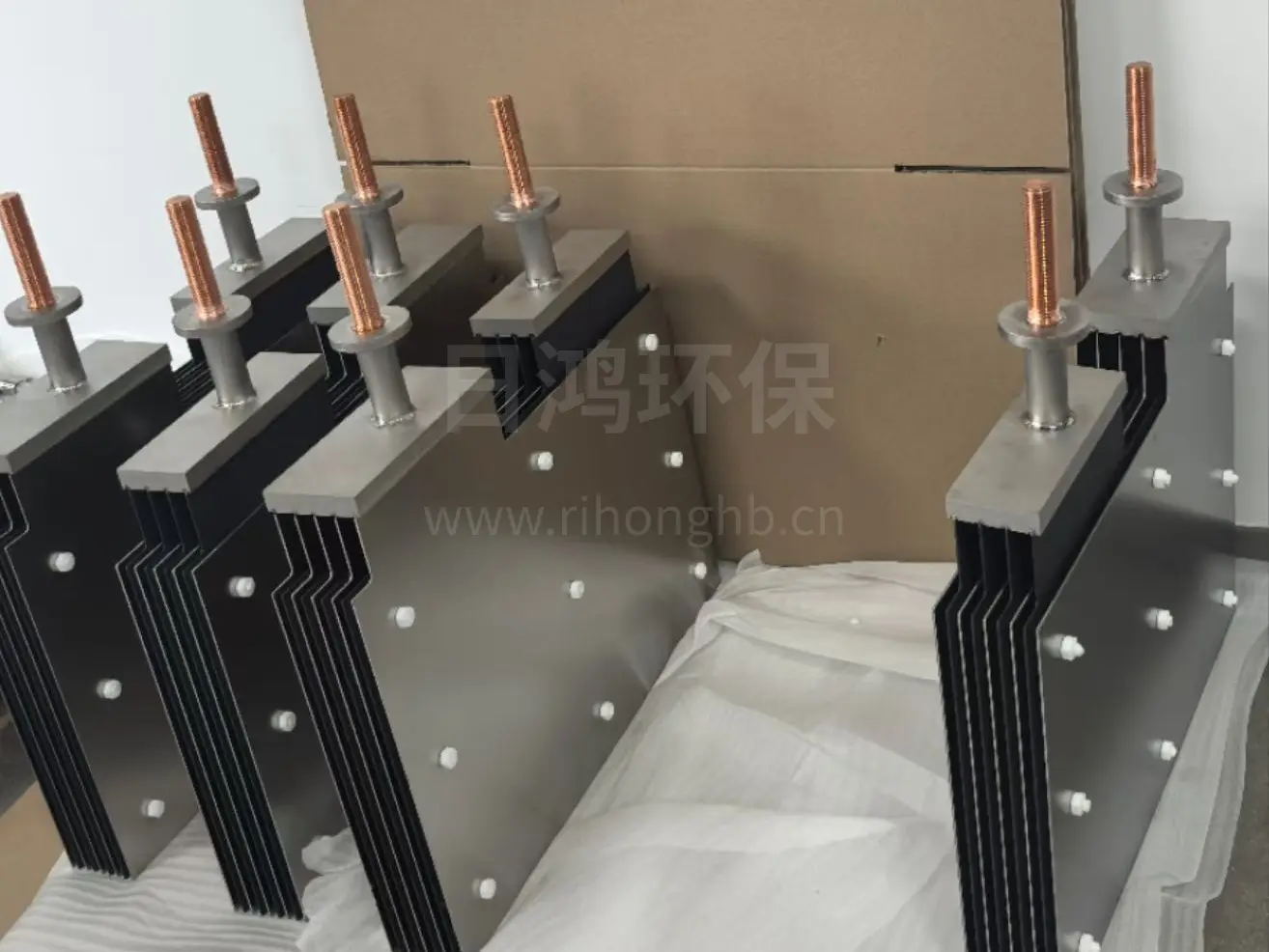
Titanium Anodes for Wastewater Treatment
The performance of electrochemical water treatment processes such as electrocatalytic oxidation, electrolytic chlorine disinfection, and electro-Fenton fundamentally depends on the electrode. Traditional soluble anodes (such as aluminum and iron) are consumed quickly, require frequent electrode replacement, and introduce additional metal ions into the water. This product is a Dimensionally Stable Anode (DSA) made with industrial pure titanium as the substrate and a noble metal oxide active layer coated on the surface. It is insoluble, long-lasting, and has tunable catalytic properties, making it the "heart" component for long-term stable operation of electrochemical wastewater treatment equipment.
I. Product Positioning
Titanium anodes for wastewater treatment are Dimensionally Stable Anodes (DSA) made with industrial pure titanium (TA1 / TA2) as the substrate, coated with a noble metal oxide active layer and sintered at high temperature. They are available with "chlorine evolution type / oxygen evolution type / platinum-based" coating systems selected according to wastewater quality and treatment objectives, and supplied in plate, mesh, tube, and rod forms. They serve as the core electrode components of electrochemical water treatment equipment such as electrocatalytic oxidation, electrolytic chlorine disinfection, and electro-Fenton cathode systems. The coating is catalytic rather than the substrate being consumed, and after service life expires, they can be returned to the factory for recoating and regeneration, making them long-life, repairable key consumables.
II. Working Principle (Brief)
Substrate pretreatment: Industrial pure titanium undergoes sandblasting and oxalic acid etching to form a uniform roughened surface, enhancing the bonding strength and specific surface area of the active coating.
Coating and sintering: A solution containing noble metal salts such as Ru / Ir / Pt / Ta is applied, followed by multiple rounds of brushing and high-temperature oxidative thermal decomposition to sinter into a dense active oxide layer.
Electric field drive: After energization, the titanium substrate conducts electricity, and the surface oxide coating becomes the active interface for electrochemical reactions, with constant electrode spacing and uniform current distribution.
Chlorine evolution reaction: Chlorine evolution type coatings (such as RuO₂-IrO₂) generate Cl₂ in chloride-containing wastewater and convert it to HClO, achieving disinfection and oxidation.
Oxygen evolution mineralization: On oxygen evolution type coatings (such as IrO₂-Ta₂O₅), water discharge generates hydroxyl radicals (·OH), which non-selectively mineralize organic pollutants.
Stable service: Dimensions remain essentially unchanged; what is consumed is the coating rather than the substrate. When service life expires, it can be returned to the factory for recoating, avoiding complete scrapping.
Process schematic: Titanium substrate → Etching → Noble metal salt coating → High-temperature sintering → Active coating anode → Tank installation and energization → (Chlorine evolution producing HClO / Oxygen evolution producing ·OH) → Organic degradation · Disinfection · Flocculation synergy → Long-life service with recoating capability
The core lies in "dimensional stability": unlike soluble anodes, titanium anodes consume the surface catalytic coating rather than the substrate itself, so electrode spacing remains constant and current density distribution is stable, making the process repeatable over the long term. Meanwhile, the catalytic coating can be customized according to the reaction objective (chlorine evolution or oxygen evolution), allowing the same substrate to adapt to different working conditions such as disinfection and mineralization.
III. Core Advantages
① Dimensionally stableDSA does not dissolve or deform, electrode spacing remains constant, current distribution is uniform, and the process is repeatable and controllable over the long term.
② Long service lifeThe coating is catalytic rather than the substrate being consumed; chlorine evolution type can reach thousands to tens of thousands of Ah/cm², and can be returned to the factory for recoating and regeneration.
③ Tunable catalysisChlorine evolution / oxygen evolution / platinum-based coatings are customized according to water quality and objectives, flexibly adapting to disinfection and mineralization.
④ Corrosion resistantTitanium substrate + oxide layer withstands complex wastewater media, has good tolerance to Cl⁻, and is suitable for high-salinity wastewater.
⑤ Controllable energy consumptionLow oxygen evolution / chlorine evolution overpotential, superior power consumption per unit treatment volume, and good operational economy.
⑥ Clean and pollution-freeDoes not introduce additional metal ions, superior to soluble aluminum/iron anodes, with stable effluent metal background.
IV. Main Technical Parameters (Reference Ranges)
Item | Parameter Range / Description | Remarks |
|---|---|---|
Substrate material | Industrial pure titanium TA1 / TA2 | Substrate not consumed, typical range reference |
Coating system | RuO₂-IrO₂ (chlorine evolution type) / IrO₂-Ta₂O₅ (oxygen evolution type) / Pt (platinum-based) | Selected according to reaction objective, typical range reference |
Working current density | 200 – 2000 A/m² | Depends on process and cell, typical range reference |
Chlorine evolution type life | ≥ 1000 – 10000 Ah/cm² | Coating gradually consumed, recoating possible, typical range reference |
Oxygen evolution type life | ≥ 500 – 5000 Ah/cm² | Depends on water quality and working conditions, typical range reference |
Operating temperature | ≤ 60 – 80 ℃ | Long-term operation upper limit, typical range reference |
pH adaptability | 1 – 12 | Depends on coating system, typical range reference |
Supply form | Plate / mesh / tube / rod (customizable) | Designed according to cell and electrode spacing, typical range reference |
* The above are typical reference values; actual service life, current density, and selection are determined by design calculations and on-site working conditions.
V. Typical Application Scenarios
Scenario / Industry | Adaptation Description / Main Function |
|---|---|
Electrocatalytic oxidation (ECO) | Oxygen evolution type coating produces ·OH, mineralizes refractory organics, deep upgrading |
Electrolytic chlorine disinfection | Chlorine evolution type generates HClO in chloride-containing wastewater/brine, sterilization of circulating water and reclaimed water |
Electro-Fenton / electrocoagulation support | Serves as insoluble anode, forms oxidation-flocculation synergy with cathode hydrogen evolution / Fe²⁺ |
High-salinity wastewater electro-oxidation | Cl⁻-resistant chlorine evolution type coating, suitable for high-salinity refractory systems |
Printing and dyeing wastewater | Chlorine evolution / oxygen evolution synergy for decolorization and COD reduction |
Pharmaceutical / landfill leachate | Deep oxidation to break down biologically toxic organics |
Circulating cooling and reclaimed water | Electrolytic online sterilization, inhibition of biofilm and scaling |
VI. Applicable Boundaries and Selection Recommendations
Chlorine evolution type coatings are suitable for Cl⁻-containing wastewater and electrolytic disinfection, but produce chlorinated by-products; evaluation is required for drinking water or scenarios with strict control of halogenated hydrocarbons. For deep oxidation targeting organic mineralization, oxygen evolution type (IrO₂-Ta₂O₅) or platinum-based coatings should be preferentially selected. During use, mechanical scratching of the active coating should be avoided, and dry firing (energization without liquid) is strictly prohibited, otherwise the coating will instantly fail.
Selection is determined by target reaction (chlorine evolution / oxygen evolution), design current density, expected service life, electrode spacing, and cell structure to determine the coating system and supply form. The same substrate can be returned to the factory for recoating with different coatings according to working conditions; recoating and regeneration at the end of service life is preferable to complete scrapping. It is recommended to first conduct small-scale tests with water samples to verify coating adaptability before bulk procurement.
Make Electrodes More Stable and Longer-Lasting
Rihong Environmental Protection can provide coating selection, form customization, and recoating regeneration services for titanium anodes dedicated to wastewater treatment. Welcome to provide water quality and working conditions to obtain a matching solution.
Contact Us Now →Related Products
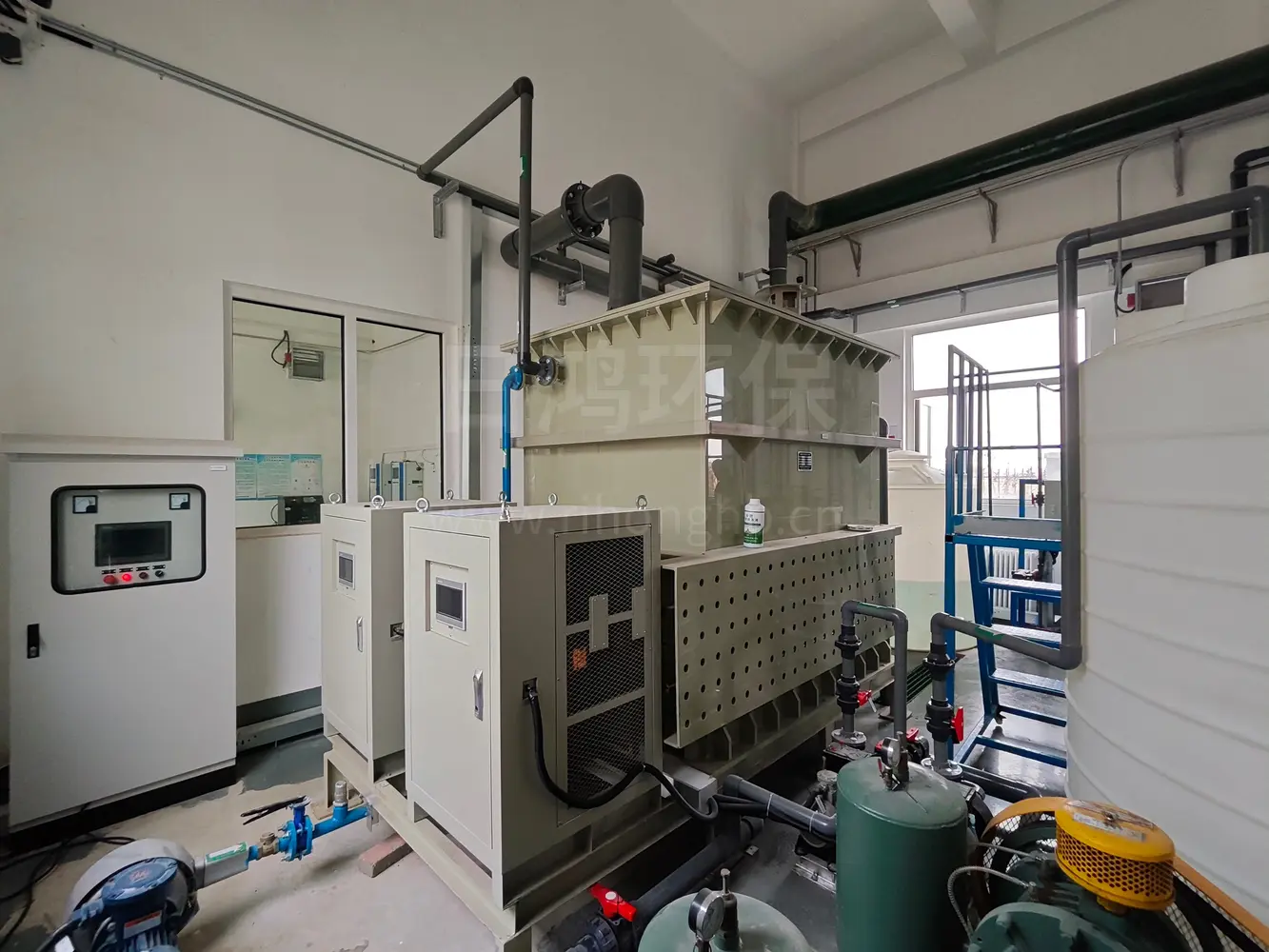
Electrocoagulation DAF Unit
Faced with complex wastewater from electroplating, printing and dyeing, petrochemical, landfill leachate and other industries—characterized by high salinity, high turbidity, oil content and poor biodegradability—traditional chemical coagulation often falls into the dilemma of high chemical consumption, large sludge volume and unstable compliance. Wushi Environmental officially launches the Electrocoagulation-Dissolved Air Flotation Integrated Unit (EC-DAF), which integrates electrolytic coagulation, electroflotation and free radical oxidation into a single unit. With no or only a small amount of chemical dosing, it simultaneously achieves coagulation, flotation separation and partial oxidative degradation, providing a cleaner and more compact technical route for the pretreatment and advanced treatment of difficult wastewater.
Boron-Doped Diamond (BDD) Electrode
Facing complex wastewater from pharmaceuticals, pesticides, dyes, and landfill leachate—characterized by "high toxicity, high salinity, and poor biodegradability"—traditional biological treatment and conventional Fenton often struggle with slow degradation, secondary sludge production, and high costs. Boron-Doped Diamond (BDD) electrodes, with their extremely wide electrochemical potential window and ultra-high oxygen evolution overpotential, in-situ enrich strong oxidizing species such as hydroxyl radicals, active chlorine, persulfate, and even ozone on the anode surface, directly "mineralizing" organic matter into carbon dioxide and water—making them the core electrode consumable for electrocatalytic oxidation (ECO) equipment to achieve deep purification.