ECO vs Fenton: Which Is More Suitable for Advanced Treatment of Refractory Wastewater?
In wastewater upgrading projects across the chemical, pharmaceutical, electroplating, and printing & dyeing industries, engineers most often agonize over one question: for the advanced oxidation stage, should we use electrocatalytic oxidation (ECO) or Fenton? Both technologies rely on the "knife" of hydroxyl radicals (·OH) to cut through organic matter, but how the "knife is sharpened" and what "residue" is left after cutting differ enormously. Choose wrong, and at best operating costs soar; at worst, iron sludge piles up into mountains and sulfate exceeds limits. This article places the two routes on a balance scale and weighs them item by item.
1. Fenton Oxidation: Fast, Fierce, but "Sludge-Producing"
Fenton is the "veteran heavy hitter" among advanced oxidation processes. Its core reaction is ferrous iron catalyzing hydrogen peroxide to explosively generate hydroxyl radicals under acidic conditions:
Fe²⁺ + H₂O₂ → Fe³⁺ + ·OH + OH⁻
Fe³⁺ + H₂O₂ → Fe²⁺ + HO₂· + H⁺  (chain cycle)
Typical dosing chain: ferrous sulfate (FeSO₄) + hydrogen peroxide (H₂O₂) + sulfuric acid (adjust pH to 2–4) + liquid caustic/lime (readjust pH after reaction) + PAM (flocculation). All told, many types of chemicals with long storage and transport chains—among them hydrogen peroxide is a hazardous chemical, with barriers to both transportation and on-site storage.
The biggest "aftereffect" is iron sludge: after the reaction ends, large amounts of Fe³⁺ form Fe(OH)₃ flocs when pH is readjusted, co-precipitating with pollutants. This sludge has high moisture content, is rich in iron and adsorbed organics, and is managed as hazardous waste; outsourced disposal costs are a perennial thorn in the operating ledger.
2. ECO: Sharpening the "Knife" In Situ on the Electrode
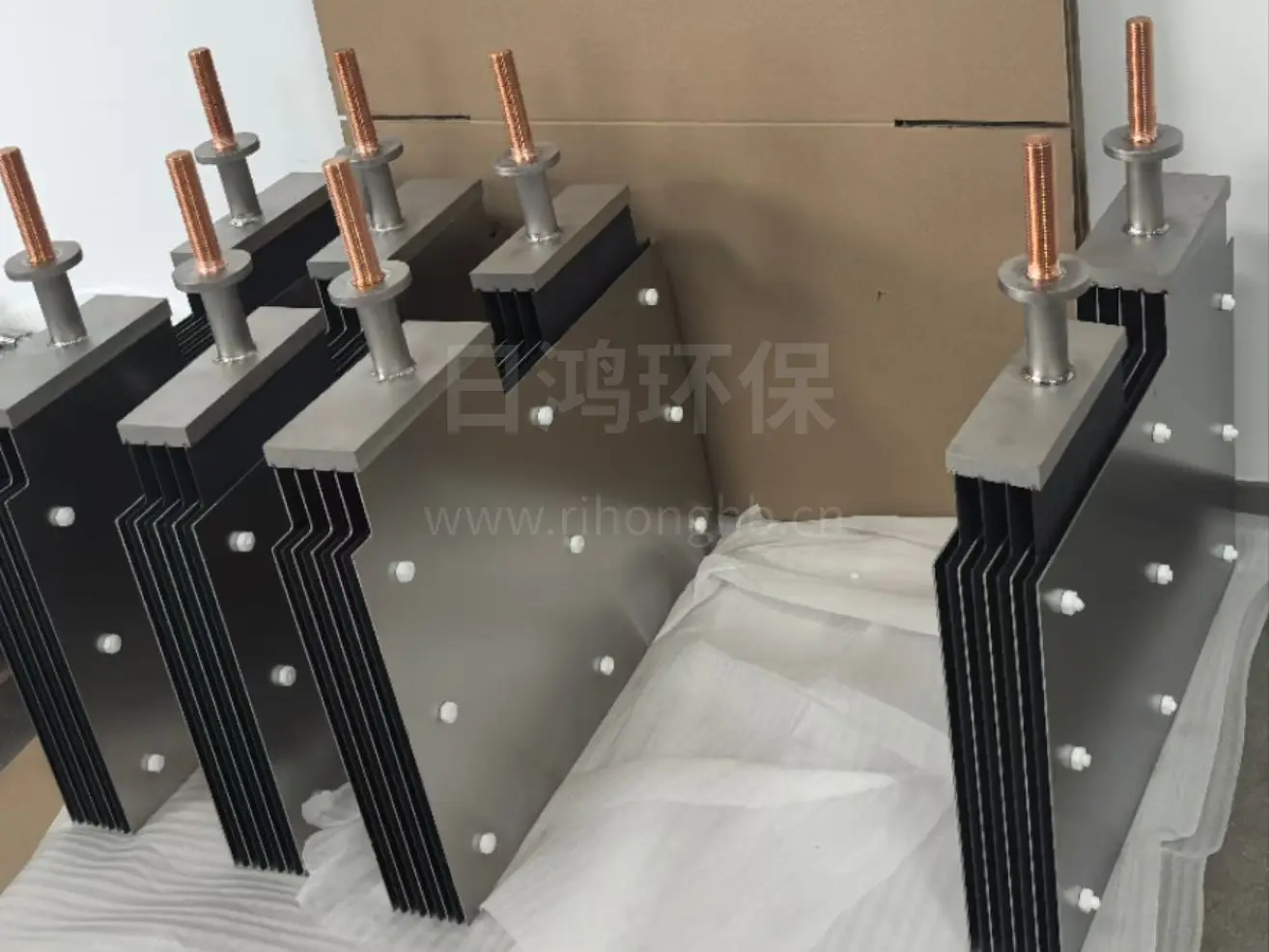
Electrocatalytic oxidation (ECO) does not "buy" radicals by dosing chemicals externally; instead, it passes current through a catalytic anode to generate reactive oxidizing species (·OH, active chlorine, etc.) "on the spot" at the electrode surface, directly mineralizing organics. For its principles and electrode selection, see High-Efficiency Electrocatalytic Equipment_Electrocatalytic Oxidation Equipment - Shandong Rihong Environmental Engineering Co., Ltd..
Its core characteristics can be condensed into six words: electricity instead of chemicals, no iron sludge. It involves no external dosing or storage/transport of ferrous iron or hydrogen peroxide, and therefore produces no chemical sludge at the source.
One-sentence connection: Fenton is "buying chemicals to oxidize"; ECO is "energizing to generate oxidizing species yourself." This is the root of all the differences that follow.
3. Core Difference Comparison (Down to Every Account Item)
Comparison Dimension | Fenton Oxidation | Electrocatalytic Oxidation (ECO) |
|---|---|---|
Source of oxidizing species | Generated by externally dosed H₂O₂ + Fe²⁺ reaction | Generated in situ electrochemically at the anode surface |
Core chemicals | Ferrous sulfate + hydrogen peroxide + acid/base | No externally dosed chemicals (only electricity needed) |
Sludge output | Large amounts of iron sludge (hazardous waste attribute) | Minimal (no chemical sludge) |
Chemical storage & transport | Hydrogen peroxide is a hazardous chemical, long chain | None |
Optimal pH window | Narrow (2–4) | Relatively wide, adjustable |
Operating cost composition | Chemical costs + sludge disposal costs | Electricity consumption (electrode life amortization) |
Secondary pollution risk | Iron salt and sulfate enrichment | High-salinity systems require control of chlorate/perchlorate byproducts |
Degree of automation | Complex dosing system, large fluctuations | Easily fully automated, programmable parameters |
Investment intensity | Low (tank + dosing) | Medium (electrodes + power supply + rectifier) |
Best-suited COD range | Medium-high (brutal knockdown) | Low-medium (advanced upgrading/detoxification) |
Reading through this table, the conclusion already emerges: the two technologies are not about "which is more advanced and which is behind," but about "which is more cost-effective within its respective cost-constraint range."
4. ECO's Differentiated Advantages: More Than Just "No Iron Sludge"
1. No iron sludge → no hazardous waste burden
This is the hardest difference. For projects requiring "zero sludge increment," "water reuse," or "tight land use," Fenton's iron sludge disposal is a structural obstacle; ECO produces almost no chemical sludge, making both environmental assessment and O&M clean.
2. Electricity instead of chemicals → more stable supply chain
Fenton's chemical prices fluctuate with the chemical market, and hydrogen peroxide and ferrous sulfate are also affected by transportation and environmental production restrictions. ECO's "raw material" is electricity—as long as power supply is stable, operation is controllable and not constrained by the chemical supply chain.
3. Controllable, fully automatable
Current density, plate potential, and retention time are all adjustable parameters; combined with PLC, fully automated operation and remote monitoring are possible. Fenton's dosing ratio requires frequent manual verification as water quality fluctuates, making stability weaker by a notch.
Engineering key point: ECO's "electricity consumption" is often cited as a shortcoming, but one must calculate the total account—factoring in Fenton's chemicals + iron sludge disposal + storage & transport + manual verification together, ECO is often actually the more economical choice in "advanced upgrading + strict sludge control" scenarios.
5. Honestly Speaking: Fenton Still Has Its Favored Scenarios
The biggest taboo in writing a comparison article is "one-sidedness." Fenton remains reasonable or even the first choice in the following situations:
• Extremely high COD requiring rapid, drastic reduction: Fenton's "knockdown" capability for high-concentration refractory COD is fierce, with simple equipment and low investment, suitable for first leveling the mountain;
• Very tight budget: Fenton's initial investment is far lower than ECO, more friendly for small water volumes and short-term projects;
• Existing hazardous waste disposal channels: When the park has its own hazardous waste incineration/landfill qualifications and iron sludge can be digested at low cost, Fenton's aftereffects are internalized;
• Intermittent/batch, small water volume: One dosing tank as backup, use and go, no need to pay for an electrode system.
So selection is not about "taking sides," but about examining constraints.
6. How to Choose: A Decision Logic for You
First look at disposal constraints: If the project strictly prohibits new sludge / requires reuse / environmental assessment blocks iron sludge → prioritize ECO;
Then look at COD position: ECO is best suited for the "advanced stage (tailwater upgrading)" and "pretreatment stage (detoxification to improve biodegradability, B/C<0.3)"; using ECO alone for the entire high-concentration large-volume stream is not economical → in that case Fenton or an "anaerobic + ECO" combination is more stable;
Calculate the total account, not unit price: Factor Fenton's chemicals, iron sludge, storage & transport, and labor into operating costs, then compare with ECO's electricity consumption + electrode amortization; in "strict sludge control" scenarios ECO often wins;
High salinity requires an additional red line: ECO in high-chloride wastewater will produce active chlorine as a byproduct, requiring control of chlorate/perchlorate accumulation, with reduction or dilution units if necessary—this is ECO's boundary, not a free lunch.
Combined process reminder: The two are not mutually exclusive. Common approaches are "Fenton rough reduction + ECO fine polishing," or "anaerobic (UASB/IC) → aerobic → ECO advanced upgrading." Placing ECO as the "final cut" saves money and reliably meets standards.
7. Rihong Environmental ECO Equipment Positioning
Rihong Environmental's flagship ECO electrocatalytic oxidation reactor follows a non-noble-metal catalytic electrode route, emphasizing "electricity instead of chemicals, no Fenton iron sludge"—it does not rely on large amounts of externally dosed Fenton reagents, and therefore produces no difficult-to-dispose iron sludge hazardous waste, making it particularly suitable for advanced upgrading and compliant discharge scenarios in chemical parks, pharmaceuticals, electroplating, and other industries.
👉 View equipment parameters and models: Rihong Environmental ECO Electrocatalytic Oxidation Equipment
👉 Not sure whether to use ECO or Fenton? Use the online selector to match by water volume/quality/sludge constraints with one click, or hand your water quality data to the technical team for process validation.
8. FAQ (Commonly Asked by Engineers)
Q1: Is ECO's electricity consumption actually high?
Electricity consumption is strongly correlated with pollutant load—the more COD to be oxidized, the more electricity consumed. So ECO's economic sweet spot is "advanced stage low-concentration upgrading" and "pretreatment detoxification," not single-handedly tackling the entire high-concentration large-volume stream. Factoring Fenton's chemicals + iron sludge + storage & transport + labor into the total account, ECO is often more economical in strict sludge control scenarios. Specific electricity consumption requires bench-scale calibration based on water quality; this article does not give blanket figures to avoid misleading.
Q2: Compared with traditional Fenton, what exactly is the difference?
In one sentence—electricity instead of chemicals, no iron sludge. Fenton relies on externally dosed ferrous iron + hydrogen peroxide to generate ·OH, producing large amounts of iron-containing hazardous waste sludge as a byproduct; ECO's oxidizing species are generated in situ at the electrode surface, introducing no external chemical sludge. See the comparison table in Section 3 for detailed differences.
Q3: Are ECO and "Electro-Fenton" the same thing?
No. Electro-Fenton generates H₂O₂ in situ at the cathode within an electrochemical system, which then reacts with Fe²⁺ to form a Fenton reaction—essentially still following the "Fenton pathway" and still involving iron; ECO is direct/indirect oxidation at the anode, not dependent on the iron cycle. The electrode roles and sludge fates are different for the two. In the next article we specifically break down electrode selection: How to Choose ECO Electrodes? DSA, Non-Noble Metal, or BDD—Who Takes the Stage?
Strict Sludge Control? Place ECO as the "Final Cut"
Rihong Environmental ECO electrocatalytic oxidation reactor, emphasizing electricity instead of chemicals and no Fenton iron sludge, suitable for advanced upgrading and compliant discharge in the chemical, pharmaceutical, electroplating, and other industries.
Contact Us Now →